



Sunday 26 June 2016
Over the years one of the most common areas I've been requested to help with is scaling, and having advised now nearly 60 Ashoka Fellows and numerous other impact projects, I was asked by Ashoka's Globalizer team to develop a toolkit for scaling social impact based on the frameworks I'd built for assessing, planning, designing and implementing scale for projects around the world.
While there are plenty of reports, articles and case studies on how different organisations have scaled, we have few practical frameworks specifically designing to guide scaling in the social sector, so it seemed like a worthwhile endeavour. I therefore put together a step by step guide that leads practitioners through the journey of scaling, from taking the initial decision all the way through to implementation.
Growing typically involves adding resources at around the same rate as adding impact or revenue. The implications are primarily operational. If you've already increased reach to more people, more cities or even more countries, but your operating costs have gone up in a generally correlated way, then what you've really done is grown rather than scaled.
Scaling differs in that it involves adding impact at an exponential rate while adding resources at only an incremental rate. Although scaling is also commonly approached from an operational perspective, it typically has significant implications for design, not only in terms of the solution being scaled, but also for the way it is delivered.
In a sector where resources are scarce and very large numbers of people are affected by social issues, it is rarely practical to increase resources at the same rate as reach of impact. Hence why the sector focuses on scaling rather than growth, and why this framework does the same.
Growth is typically the first stage on the path to scaling. Once you've developed and proven a solution, then the next stage is to grow your reach in a direct and controlled manner in order to understand the process as well as the transferability of your solution.
Only when you've grown to a stable operational size and have understood what does and doesn't work in terms of both impact and operation, should you really start to think about scaling. This isn't necessarily what all organisations do, and many have scaled without taking this position, but the result is typically messier, less impactful and harder work than expected.
The general assumption is that the main barrier to scaling lies with access to funding, when in fact financing challenges are often just a symptomatic outcome of underlying readiness and scalability issues.
There are actually five key reasons why organisations struggle to address the real scale of need around the world.
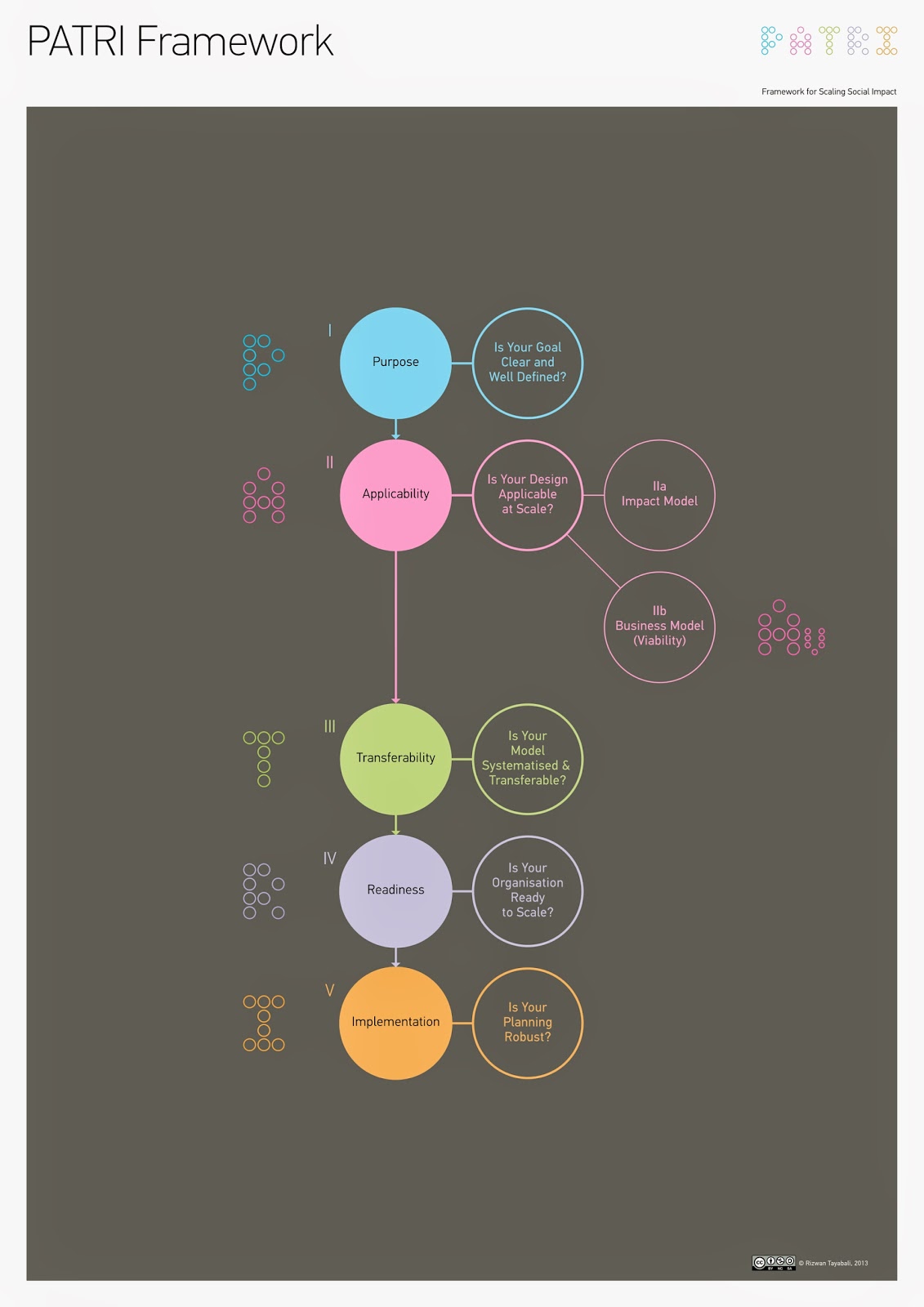
The result is a quality improvement and risk management approach to scaling that should help you on two fronts
If you aren't sure quite how to do this yourself, then each of the main Framework questions has been further broken down into more detailed questions, instructions and guidelines. These will lead you through a journey that covers the most important factors you will need to consider and evaluate when scaling.
While there are plenty of reports, articles and case studies on how different organisations have scaled, we have few practical frameworks specifically designing to guide scaling in the social sector, so it seemed like a worthwhile endeavour. I therefore put together a step by step guide that leads practitioners through the journey of scaling, from taking the initial decision all the way through to implementation.
Scaling vs. Growth
Scaling essentially refers to a form of growth. However, there is an important distinction.Growing typically involves adding resources at around the same rate as adding impact or revenue. The implications are primarily operational. If you've already increased reach to more people, more cities or even more countries, but your operating costs have gone up in a generally correlated way, then what you've really done is grown rather than scaled.
Scaling differs in that it involves adding impact at an exponential rate while adding resources at only an incremental rate. Although scaling is also commonly approached from an operational perspective, it typically has significant implications for design, not only in terms of the solution being scaled, but also for the way it is delivered.
In a sector where resources are scarce and very large numbers of people are affected by social issues, it is rarely practical to increase resources at the same rate as reach of impact. Hence why the sector focuses on scaling rather than growth, and why this framework does the same.
Growth is typically the first stage on the path to scaling. Once you've developed and proven a solution, then the next stage is to grow your reach in a direct and controlled manner in order to understand the process as well as the transferability of your solution.
Only when you've grown to a stable operational size and have understood what does and doesn't work in terms of both impact and operation, should you really start to think about scaling. This isn't necessarily what all organisations do, and many have scaled without taking this position, but the result is typically messier, less impactful and harder work than expected.
Scaling Challenges
Scaling is a critical shift in your ability to make a difference, and one that has significant implications for your organisation. There is a current trend towards rushing into scale, with a focus on quick wins, but this is a misleading and high risk approach in terms of both impact and organisational stability. Planning to scale should not be taken lightly, and it is important to put the right foundations in place if you want to ensure your ability to generate impact on a large scale without putting your organisation or the outcome at risk of failure.The general assumption is that the main barrier to scaling lies with access to funding, when in fact financing challenges are often just a symptomatic outcome of underlying readiness and scalability issues.
There are actually five key reasons why organisations struggle to address the real scale of need around the world.
- Lack of outcome oriented purpose with poor problem definition, which leads to failures in design and decision making
- Inapplicable/Non-scalable impact methodology (solution), which limits the flexibility needed to address the varying needs of new environments and demographics
- Non-systematic approaches to set-up and implementation, which limits replicability and decreases both efficiency and effectiveness
- Inflexible organisational design and lack of operational readiness, which limits ability to deliver at scale
- Poor implementation planning, and hence inadequate cost modelling, leading to challenges with raising funds or finance.
The PATRI Framework for Scaling Social Impact
At its highest level, the Framework consists of a corresponding set of five key questions that will help you scale successfully- Is your goal valid and well defined? (Purpose)
- Is your design applicable at scale? (Applicability)
- Is your model systematised and transferable? (Transferability)
- Is your organisation ready to scale? (Applicability)
- Is your implementation planning robust? (Implementation)
- P = Purpose
- A = Applicability
- T = Transferability
- R = Readiness
- I = Implementation
- Improve ability to address or eradicate issues on a large scale/systemic level
- Reduce risk of mission drift/organisational failures caused by overstretching
If you aren't sure quite how to do this yourself, then each of the main Framework questions has been further broken down into more detailed questions, instructions and guidelines. These will lead you through a journey that covers the most important factors you will need to consider and evaluate when scaling.
Tuesday 5 January 2016
Video not working? Watch it on the TEDx Youtube channel here.
Alternatively, if you haven't the time to watch it here's the full transcript, which also contains some detail and anecdotes I skipped while delivering it on stage.
-------
(im)Possible Change

In sub-Saharan Africa 1 in 8 children dies before their first birthday
More than 30 million people are living with HIV or AIDS around the world
Globally more than a 100 million women are estimated to be missing - which is a soft way of referring to the gender bias in mortality due to abortion, female infanticide or insufficient care given to girls. India by itself accounts for nearly 50 million of these. That’s not even talking about the frightening numbers that have been trafficked or married off before they have even had time to finish childhood.
I could go on, but instead let’s pause for minute and do a quick two step exercise.
Step 1 - Take a moment to think of one big issue that really pains you. Something widespread or pervasive.
Step 2 - Consider whether you genuinely believe that you personally could do something to fundamentally impact or eradicate that issue within your own lifetime?
More often than not, the answer to the second question is a less than confident 'maybe', or an outright 'no'. In essence this reflects the difference between what you know could potentially be achievable, but on a practical level for you feels pretty much impossible.
----
What if I told you however, that it actually might be more doable than you think?
See, the interesting thing about the human brain is that if it doesn't understand something, it thinks it's impossible. People are typically able to work really hard on things within their comfort zone, but they often get paralysed when they have to work hard at things they don't understand. They simply don't know where to start and so they either give up, procrastinate or default to whatever it is they feel able to cope with.
Take a Rubik’s cube for example. We all know they are possible to solve, but for most of us it only takes a couple of attempts to conclude that there’s probably some kind of magic involved that’s completely beyond us. But the fact is there are people out there who can solve them in under 10 seconds. Some can even do this one handed. The thing is they understand what they are doing. It is not complicated for them.
And just like the Rubik’s cube, solving our biggest social challenges can actually be straightforward for all of you too, once you understand what you’re doing, and if you are willing to put in the time in to get that understanding.
---
If it's so simple why don't we do this as a matter of course?
The trouble is that understanding the problem takes a lot of leg work and time, and we live in a world of ideas and instant gratification. We are looking for magical fixes and quick solutions. The urgency of the problems we see drives us to rush in and get started.
The result is that many solutions and approaches are built almost entirely on assumption. For the most part we get close enough to make a difference, but it isn't enough to fundamentally dismantle the really big challenges.
Fortunately, in order to really the understand any given social challenge you actually only need to do two things
- Investigate the problem
- Immerse yourself in it
Immersing yourself in it however involves making it part of your life experience. Being at the coalface, getting on the ground and observing or helping deal with the issue over a significant period of time.
---
A great example of what it takes to really understand the dynamics of a social situation can be found in a book called The Corner by David Simon and Ed Burns. If you’ve ever watched The Wire you’ll know the one I mean. It chronicles the life of poverty on the drug riddled corners of West Baltimore in the United States, and took years to write.
The authors rarely offer their own opinion, but in the few pages that they do, it is enlightening. You're left in no doubt that they have fully understood both the ecosystem and root causes of the outcomes they document.
If they chose to address these issues, no doubt they would develop powerful solutions that actually might work, as compared to those of us who pile in with lightly considered interventions.
The point is that they didn't do anything special, complicated or impossible. All they did was invest the time both to investigate and immerse themselves in a social situation that moved them.
---
The key here is the amount of time. By the time The Corner was published, David Simon had been immersed in that reality for 13 years. If you're serious about tackling a systemic issue, the first building block of success is whether or not you're in it for the long run.
If you are, then the good news is that when it comes to tackling big social issues, all you really need is three things to make the impossible possible
---
A great example of what it takes to really understand the dynamics of a social situation can be found in a book called The Corner by David Simon and Ed Burns. If you’ve ever watched The Wire you’ll know the one I mean. It chronicles the life of poverty on the drug riddled corners of West Baltimore in the United States, and took years to write.
The authors rarely offer their own opinion, but in the few pages that they do, it is enlightening. You're left in no doubt that they have fully understood both the ecosystem and root causes of the outcomes they document.
If they chose to address these issues, no doubt they would develop powerful solutions that actually might work, as compared to those of us who pile in with lightly considered interventions.
The point is that they didn't do anything special, complicated or impossible. All they did was invest the time both to investigate and immerse themselves in a social situation that moved them.
---
The key here is the amount of time. By the time The Corner was published, David Simon had been immersed in that reality for 13 years. If you're serious about tackling a systemic issue, the first building block of success is whether or not you're in it for the long run.
If you are, then the good news is that when it comes to tackling big social issues, all you really need is three things to make the impossible possible
- A solution that works – i.e. An approach, methodology or solution that works, and by works I mean is capable at least in theory of achieving your vision at an individual or local scale.
- An infrastructure that can deliver it effectively (and for long enough to prove transformational impact) – i.e. An organisation, network or coalition that can deliver it effectively, and by this I mean an organisation that is capable of consistently delivering this impact.
- A way to reach everyone who needs it - Once you’ve got the solution and infrastructure in place you need a practical way to reach everyone that needs it. In other words you need to a practical way to meet the real scale of the problem you are trying to address.
---
To help you understand what I mean lets use an example of a great organisation I worked with in Chile.
Most people don’t genuinely believe that we can address real poverty, but Rodelillo is doing it, and doing it well.
---
Most people don’t genuinely believe that we can address real poverty, but Rodelillo is doing it, and doing it well.
- They have a solution that works: It was developed through deep understanding of the problem, based on the founder Maca Currin’s personal life experience, and targeted at a vision of completely transitioning families out poverty. And by this I don’t mean increasing income by some small percentage, but real outcomes that achieve stable employment, home ownership, and the ability to send children to university.
- They have an organisation that can deliver it effectively: Over 25 years, 30 full time staff and an army of volunteers have directly impacted 35,000 families and thus proved that the solution is capable of achieving this vision with a success rate of more than 90% of families transferring out of poverty.
- They are now working on ways to reach all the people who need it and they are doing it through government adoption. The Ministry of Development and Planning (MIDEPLAN) recently designed a program modelled on Rodelillo's approach. Called the Bridge Program, it will serve 250,000 families over the next three years.
---
The answer is that we start with ideas instead of starting by understanding the problem, and the ideas we have are commonly driven by solutions we are already familiar with.
So effectively we start with solutions and then try and fit them to whatever we know about have of the issue we are concerned about. I call these “solution based solutions”.
Here’s an example:
We see children playing on the street in a village near us and figure they'd be better off in school. We build a school, grab the state curriculum, find some teachers and away we go. Our friends think we’re amazing, and funders give us money because everybody 'knows' that education is a good thing. However if we had stopped to immerse ourselves in their life we might have realised that what they really needed to learn is not covered in the average state curriculum and isn’t transferable through classroom based learning. They need to know how to use their land, and the assets available to them. However, instead of teaching them about irrigation we teach them about rainfall in Russia.
Had we investigated further, we might have realised that they needed a range of other forms of developmental support that extend beyond technical education. If we followed them past school, we’d probably see them migrate to unfamiliar urban environments needing life skills that our school didn’t prepare them for. We might even look for solutions to stem that migration, instead of realising that we were the ones causing it with an educational solution that disconnected them from their home environment.
Effectively then, when it comes to tackling big issues people usually start with the solution, strategies, vision, or mission, instead of where they should start, which is by understanding the problem. The reason is that most of us are excited by the creativity and challenge behind these ideas and solutions, and not the grunt work and time required to immerse ourselves in issues.
---
In reality without a sensible problem definition you can’t establish a meaningful vision, because your vision should be a detailed picture of what the problem looks like when it’s fixed.
Instead you end up with solution oriented one-liners - things like "One day all children will get an education that matters." What does 'matters' even mean? And education isn't a vision anyway. It's just a strategy. If your vision was a world where children are free from persecution, that would at least make more sense as a vision. But then you'd have to clarify what you mean by persecution. Is it child labour, sexual abuse, bullying, harassment, domestic violence? Where do you draw the lines between harmless teasing for example and harassment or bullying? Either way you can see where I'm going. You need detail and clarification. And you can only get that detail if you understand the problem you are trying to fix.
So to reiterate, without a good understanding of the problem you can't establish a clear vision, and the trouble is that without a detailed vision you can't establish meaningful targets.
Without targets you have nothing concrete to aim for, and your strategies consequently lack focus. You're doing a lot of stuff but it isn't necessarily going anywhere. Like the baseball legend Yogi Berra once said – “If you don't know where you're going, you might end up someplace else.”
The reality is that everything related to delivering impact is interlinked, and all of it sits upon a foundation of good problem definition.
What you need then is true "problem based solutions".
---
Here's a framework I use to show it all fits together. Think of it as a full stack meta-model for solution design. I’m not going to explore it here, but I’ve put up a video online that talks you through it. You can find it here with a full transcript or just the video on Youtube if you’re interested to know more.
You can see not only how solution design starts from understanding the problem, but also how organisational structure and roadmaps for the future are tied to it too.
The other interesting outcome of understanding the problem is that it actually simplifies the solutions we need. There may be lots of surface characteristics and apparent nuances, but once you can see how they fit together, you often find there’s only a small number of root causes.
---
At Make A Difference after 8 years we've learnt this the hard way. We are familiar with the experience of children in shelters, but we don't really know what happens to them after they've grown up. Nobody out there seems to be tracking this. Without that baseline we will have no idea if our interventions are actually making a difference in the long run. We've therefore embarked on a journey to really understand the problem we are dealing with, and are changing our solutions to make them capable of adapting as we learn.
Trying to find out what has happened to adults who grew up in shelters isn't easy. There's no database to use, no telephone lists or email addresses. Our research teams are doing the leg work to find people and are then immersing in their reality by investing the time to build relationships with them. As we do this, we're finding that what initially seemed like an impossible task of overwhelming complexity, is actually full of manageable patterns that we can wrap our heads around. There's only so many routes of entry into shelters. Only so many types of shelters, and only so many outcomes we need to worry about. For any given aspect, there are already focused interventions that have been developed by others. We don't even need to reinvent the wheel. We just need to tie them together.
In the end they all boil down to a handful of drivers which can loosely be clustered into two groups
For empowering children we need to consider emotional health, life skills, education, work readiness and after-care. Of these after-care is probably the most unintuitive. You really need to understand the trajectory of the lives of disadvantaged children to know that they need personal and logistical support well into early adulthood. We take this for granted with our families, but because it isn’t a familiar solution most interventions don’t cater for this. At Make A Difference we are looking at support systems all the way up to the age of 28.
When it comes to enabling institutions, there are five key ones that impact children in shelters. The shelters themselves, school, family, state and society.
As an organisation we are faced with a choice. Either we try and do it all ourselves, or we specialise in one or more of the pieces, while partnering or outsourcing to others who can fill in the gaps.
Trying to find out what has happened to adults who grew up in shelters isn't easy. There's no database to use, no telephone lists or email addresses. Our research teams are doing the leg work to find people and are then immersing in their reality by investing the time to build relationships with them. As we do this, we're finding that what initially seemed like an impossible task of overwhelming complexity, is actually full of manageable patterns that we can wrap our heads around. There's only so many routes of entry into shelters. Only so many types of shelters, and only so many outcomes we need to worry about. For any given aspect, there are already focused interventions that have been developed by others. We don't even need to reinvent the wheel. We just need to tie them together.
In the end they all boil down to a handful of drivers which can loosely be clustered into two groups
- The child’s ability to cope and flourish
- The impact of institutions or agents that affect their development and progression
- Empower children and
- Enable the institutions that impact them.
For empowering children we need to consider emotional health, life skills, education, work readiness and after-care. Of these after-care is probably the most unintuitive. You really need to understand the trajectory of the lives of disadvantaged children to know that they need personal and logistical support well into early adulthood. We take this for granted with our families, but because it isn’t a familiar solution most interventions don’t cater for this. At Make A Difference we are looking at support systems all the way up to the age of 28.
When it comes to enabling institutions, there are five key ones that impact children in shelters. The shelters themselves, school, family, state and society.
As an organisation we are faced with a choice. Either we try and do it all ourselves, or we specialise in one or more of the pieces, while partnering or outsourcing to others who can fill in the gaps.
Conventional wisdom suggests that focusing is more practical approach, but however we do it, we need to ensure that one way or another the children we work with receive the full complement of interventions they need to break poverty and abandonment cycles. As we understand the problem better we will also understand how to prioritise and focus better, but at the very least we see this as a long term challenge, with a goal of making a lasting difference on a collective macro scale over the next 25 years.
It will take a while, but we believe that with the right foundations and a sensible time-frame, transforming adult outcomes for the millions of children in shelters across India is actually an achievable mission.
--
--
Which brings us back around to the question of whether or not individuals like you or me can fundamentally impact or eradicate the biggest and most pervasive challenges of our times.
The truth is if someone had told me when I first started out as a volunteer working with inner city teenagers while at university, that some day it might be possible for me personally to think about eradicating the inequalities faced by the millions of children currently in shelters in India, I would probably have thought they were crazy.
But after nearly two decades of working with impact projects all over the world I've started to understand the patterns in the social problems we face, and it all seems eminently more achievable than I imagined back then. All you need is to put in the effort to really understand the issue, and then be prepared for the real time-frames needed to make change on a systemic level.
If we put in the effort and time to build and deliver true 'problem based solutions', I firmly believe that we can eliminate many of these challenges in our own lifetimes.
I hope this talk has made you rethink your ability to make a difference to that one big issue that pains you. It won't be easy, but certainly it isn't impossible!
Thursday 29 November 2012
One of the most common issues I've seen on the ground is clarity of, and coherence between, Vision, Mission and Strategy. This is often the root cause behind poor solution design, difficulties in achieving lasting outcomes, and challenges with raising money.
To make it easier to explain how they fit together and the order in which they should be developed, I've put together a short video that connects the dots for you.
The video is based on learnings from my work with more than 100 projects around the world. I'll try and address common issues, myths and challenges faced by social organisations in both designing for outcomes as well as delivering them.
The video is based on learnings from my work with more than 100 projects around the world. I'll try and address common issues, myths and challenges faced by social organisations in both designing for outcomes as well as delivering them.
[Note: If the video doesn't play in your browser, view on YouTube at http://youtu.be/aRcox743Dfg]
Here's the transcript with a downloadable graphic in case it makes the video easier to process:
Very simply, with social change, direction is laid down by your vision, and your mission is to achieve that vision. The trouble is that if your vision isn't clear or sensible, you end up without proper direction, and consequently without a proper basis for design. Your strategies end up all over the place, and you become very susceptible to mission drift. Outcomes lose coherence, and impact becomes a random pick n mix. Donors struggle to connect with unclear goals, and shy away from disconnected strategies. The end result as I mentioned earlier, is a struggle for survival, but more importantly a struggle to achieve the impact that is needed on the ground.
After addressing this issue a number of times, I've put together an easy DIY toolkit to help you visualise how all the pieces connect together.
Let's call it a Metamodel of Solution Design. A blueprint for your organisation. To keep it short, I'll focus here on a high level overview to show how everything connects, but I'll explore each piece and provide working examples in later posts to help make it a little more real.
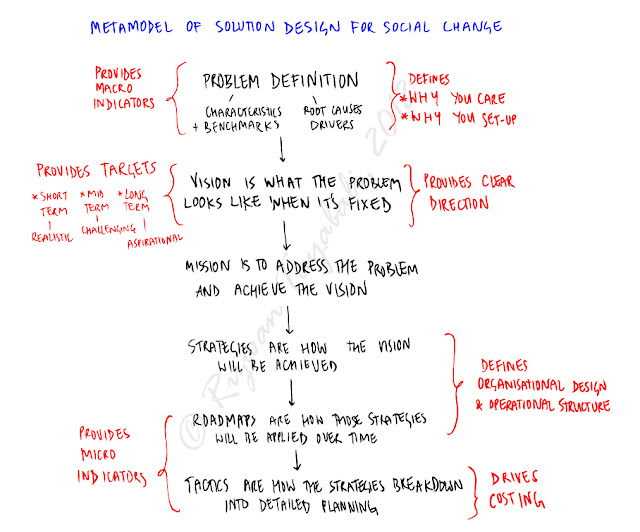
People tend to start with either vision or mission, and sometimes even with strategies. In actual fact the first place to start is with the Problem Definition.
Without a good characterisation and deep understanding of the problem, none of the other aspects of solution design have any hope of being effective.
Contrary to general assumption, the problem definition is not a one-line statement. What we're talking about here is a detailed picture of the problem at hand, with data that validates and benchmarks the outcomes that indicate there is a problem that needs addressing.
Once you've got these, you need to understand the root causes behind those characteristics; in other words, understand what drives the problem.
The benchmarks in your problem definition will allow you to identify Macro Indicators, and thus the outcomes to aim for. These should be lasting % point changes on a regional level over a mid to long time-frame. Over time they will also tell you if your strategies are actually achieving anything useful, and whether or not you need to rethink.
Critically, the problem definition defines why you care, and why you set up your organisation in the first place. It is the fundamental basis for your existence as a social entity, so invest the time to get it right.
----
Once you have the problem well defined - you can then move on to Vision.
Your vision is what the problem looks like when it's fixed. Again, what is needed here is a detailed picture rather than a single statement. With this, you have the potential to inspire, and you have a proper target to aim for. You can later summarise this into a one-liner for communication purposes.
The vision also helps you define your targets. I recommend splitting it into at least three phases - a short term realistic vision, a mid-term challenging vision, and a long term aspirational one.
Overall your vision provides goals and direction. It is the fundamental basis for design and decision making.
----
Once you've got this in place, your Mission is then to address the problem and achieve the goals and targets set by your vision.
----
Your Strategies are how you will achieve the mission. In other words, how you aim to fix or eradicate the problem altogether. Focus your strategies on the root causes identified in the problem definition.
----
Roadmaps are how those strategies will be applied over the timeframes you set to achieve the mission. This is where you identify short and long term programmes, and understand dependencies and priorities.
----
Tactics are how your strategies breakdown into actions and delivery planning along the phases of your roadmap.
You are free to focus maximum detail on the short term, because the roadmap lets you understand what needs to come next. Keep your planning light for the later stages, because your blueprint will evolve as you go along.
----
Strategies and roadmaps together help define Organisational Design and operational structure, along with how they will need to scale or evolve over time.
---
Roadmaps and tactical programmes provide your Micro Indicators. These are numerical increases in size, impact or reach in short timeframes. Many organisations use these as actual impact indicators, but this is a flawed approach. All they do is tell you if you're on track with your plan. They don't necessarily mean that your plan or strategies are solving the problem in the long term, which is what your design should be aiming for.
----
Finally, your detailed tactical planning enables you to Cost your work, which then allows you to raise the appropriate financing or funding.
----
I recommend reviewing the whole conceptual framework about 9 months into an annual cycle. You should aim to adjust targets, strategies and roadmaps based on learnings and/or how the environment is changing.
Then repeat the detailed tactical planning for the next year with higher level adjustments across the rest of the time-frame where needed.
If you've taken the time to really understand the problem, your core vision and mission on the other hand should remain constant until data on macro outcomes indicates that the problem has been resolved or that it is no longer an issue.
At this point you and your organisation are ready to exit that particular space. You can then choose to close down, or switch attention to another issue. With human transformation work, you're typically looking at between 8 and 15 years as a sensible time-frame to really start seeing impact on a macro level. Resolving an embedded issue altogether will likely take you even longer. Regardless of what anyone tells you, there are no quick fixes and no magic bullets.
Many thanks to Akshay Cherian for helping me put this together, and credit to Barbara Holtmann for coining the phrase 'what it looks like when it's fixed', although I've used it here in a slightly different context.
Thanks for tuning in. Please share if you found it useful.
Here's the transcript with a downloadable graphic in case it makes the video easier to process:
Very simply, with social change, direction is laid down by your vision, and your mission is to achieve that vision. The trouble is that if your vision isn't clear or sensible, you end up without proper direction, and consequently without a proper basis for design. Your strategies end up all over the place, and you become very susceptible to mission drift. Outcomes lose coherence, and impact becomes a random pick n mix. Donors struggle to connect with unclear goals, and shy away from disconnected strategies. The end result as I mentioned earlier, is a struggle for survival, but more importantly a struggle to achieve the impact that is needed on the ground.
After addressing this issue a number of times, I've put together an easy DIY toolkit to help you visualise how all the pieces connect together.
Let's call it a Metamodel of Solution Design. A blueprint for your organisation. To keep it short, I'll focus here on a high level overview to show how everything connects, but I'll explore each piece and provide working examples in later posts to help make it a little more real.

People tend to start with either vision or mission, and sometimes even with strategies. In actual fact the first place to start is with the Problem Definition.
Without a good characterisation and deep understanding of the problem, none of the other aspects of solution design have any hope of being effective.
Contrary to general assumption, the problem definition is not a one-line statement. What we're talking about here is a detailed picture of the problem at hand, with data that validates and benchmarks the outcomes that indicate there is a problem that needs addressing.
Once you've got these, you need to understand the root causes behind those characteristics; in other words, understand what drives the problem.
The benchmarks in your problem definition will allow you to identify Macro Indicators, and thus the outcomes to aim for. These should be lasting % point changes on a regional level over a mid to long time-frame. Over time they will also tell you if your strategies are actually achieving anything useful, and whether or not you need to rethink.
Critically, the problem definition defines why you care, and why you set up your organisation in the first place. It is the fundamental basis for your existence as a social entity, so invest the time to get it right.
----
Once you have the problem well defined - you can then move on to Vision.
Your vision is what the problem looks like when it's fixed. Again, what is needed here is a detailed picture rather than a single statement. With this, you have the potential to inspire, and you have a proper target to aim for. You can later summarise this into a one-liner for communication purposes.
The vision also helps you define your targets. I recommend splitting it into at least three phases - a short term realistic vision, a mid-term challenging vision, and a long term aspirational one.
Overall your vision provides goals and direction. It is the fundamental basis for design and decision making.
----
Once you've got this in place, your Mission is then to address the problem and achieve the goals and targets set by your vision.
----
Your Strategies are how you will achieve the mission. In other words, how you aim to fix or eradicate the problem altogether. Focus your strategies on the root causes identified in the problem definition.
----
Roadmaps are how those strategies will be applied over the timeframes you set to achieve the mission. This is where you identify short and long term programmes, and understand dependencies and priorities.
----
Tactics are how your strategies breakdown into actions and delivery planning along the phases of your roadmap.
You are free to focus maximum detail on the short term, because the roadmap lets you understand what needs to come next. Keep your planning light for the later stages, because your blueprint will evolve as you go along.
----
Strategies and roadmaps together help define Organisational Design and operational structure, along with how they will need to scale or evolve over time.
---
Roadmaps and tactical programmes provide your Micro Indicators. These are numerical increases in size, impact or reach in short timeframes. Many organisations use these as actual impact indicators, but this is a flawed approach. All they do is tell you if you're on track with your plan. They don't necessarily mean that your plan or strategies are solving the problem in the long term, which is what your design should be aiming for.
----
Finally, your detailed tactical planning enables you to Cost your work, which then allows you to raise the appropriate financing or funding.
----
I recommend reviewing the whole conceptual framework about 9 months into an annual cycle. You should aim to adjust targets, strategies and roadmaps based on learnings and/or how the environment is changing.
Then repeat the detailed tactical planning for the next year with higher level adjustments across the rest of the time-frame where needed.
If you've taken the time to really understand the problem, your core vision and mission on the other hand should remain constant until data on macro outcomes indicates that the problem has been resolved or that it is no longer an issue.
At this point you and your organisation are ready to exit that particular space. You can then choose to close down, or switch attention to another issue. With human transformation work, you're typically looking at between 8 and 15 years as a sensible time-frame to really start seeing impact on a macro level. Resolving an embedded issue altogether will likely take you even longer. Regardless of what anyone tells you, there are no quick fixes and no magic bullets.
Many thanks to Akshay Cherian for helping me put this together, and credit to Barbara Holtmann for coining the phrase 'what it looks like when it's fixed', although I've used it here in a slightly different context.
Thanks for tuning in. Please share if you found it useful.
Tuesday 20 November 2012
This post is about new alternative financing options and the challenges they present to social entities around the world.
Along my journeys around the world, I worked with more than a hundred social organisations of all types. From ‘first storey’ ones running programmes to secondary and tertiary social institutions like funding intermediaries and foundations. The full list is here. Given the financial stresses that the world is currently under, I’m sure you can imagine that much of my time was spent in helping design new structures and approaches for reducing dependency on traditional fund-raising.
The big challenge that non-profits, intermediaries and social entrepreneurs have been facing is that traditional funding has dried up with the recession, while at the same time the number of entities effectively vying for the same funds is increasing as the internet levels the global playing field. Couple this with the fact that most funders haven’t really got a clue what they’re doing and you’ve got a situation where organisations are forced into a pied piper situation. Follow the funder into whatever hole they dictate. This is both demoralising and unproductive en-route to any desired social impact.
In most countries around the world, there is also limited or no Government funding for social or non-profit enterprises, so organisations are having to consider other alternatives.
The simple reality is that transformative work can rarely be funded by revenue generating activities alone. It takes between 8 and 15 years to really transform the lives and environments of people and communities and that kind of intensive support and interaction can rarely be funded by peripheral revenue streams. If a social organisation in the transformation space is able to cover 15 or 20% of its operating cost through its own revenue streams, it’s usually doing pretty well.
The danger of revenue streams is that they often feel like high priority even though they are not the primary finance source. This means that they can often drain the time and energy of the leaders of the organisation away from the social mission, or worse still result in significant mission drift. The best way to take on revenue streams is to ensure that they have their own dedicated people and that they spin off from work that the organisation already does in delivering its social mission.
Unfortunately, there's only a certain number of corporates large enough and interested enough to run social sponsorship programmes. In Mexico for example there were probably only about 20 obvious candidates... HSBC, AXA, Zurich Bank, Scotia Bank, Axtel, Kleenex, Kotex, Marti, Danone, Wal-Mart, Gamesa, Colgate, Novartis, Pfizer, Cemex, Bimbo, P&G, Cadbury, Kraft, Pepsi Co and Femsa - and only about 2 of these were actually local companies. What I found therefore was that social organisations, large and small, were all competing for funding from the same players. The small ones can't really compete with the bigger organisations, and the bigger organisations need more funding than is now available after the recession, so nobody wins except the funder, whose primary goal is brand kudos and audience recognition.
I'm not sure what the solution is, but I'd imagine that if all these companies and foundations co-operated to create a single fund, and then split this to cater for larger umbrella organisations and smaller grassroots organisations separately, there'd be a better distribution of funding. Specifying focus areas would still allow companies to be associated with the projects that fit the image they want to project, and they'd all benefit from the economies of scale and removal of duplication of administrative effort and cost.
My usual advice is that if your organisation isn’t simply an alternative business, and doesn’t have legal, contractual and financial expertise equivalent to that of the investing entity, the power imbalance is too steep. However good it looks on the surface; best avoid.
Where organisations start out as social businesses or ‘social enterprises’ they may avoid the problem of managing business models in context, but immediately face the ongoing challenge of balancing out social impact and profit. This is simple enough with one-dimensional products or services like solar lamps or microfinance, but not so easy with long term transformative or development goals. The big myth being perpetuated by the sector is that impact and profit are not mutually exclusive, but in reality they often collide head-on. The ongoing exploitation and failures of Microfinance across the world are a good example of this. At some point the commercial entity’s priority typically shifts from social benefit to financial survival and/or growth. Without very clear ongoing definitions and regulation of priority, the grey area often blurs and we’ve ended up in a sector that is massively based on spin.
It is definitely possible and desirable to design transformative programmes so they can be self-financing, but the sector is neatly ignoring the fact that they take longer to break-even than equivalent businesses that don’t have to cost for ethical and development practices. These entities may be financially viable but are unlikely to ever make serious money for their owners, and the number of small and mid-sized social enterprises that operate at survival levels bears this out.
Out in the field and away from the ‘first world’, I found most social enterprises to maintain non-profit rather than commercial status. Their charity status usually goes a long way towards subsidising costs and provides them with alternate means of financing if their revenue streams fail to meet operating expenses in the pursuit of social impact.
It’s specific to their context, but you’ll get the jist.
Some organisations like Sustentavia are also starting to provide this improved operating capacity as consultancies. They have clever business models which recognise that you can't really expect cash strapped social organisations to pay for services up front when they don't have the money, and hence aim for long term partnerships and investment in future financial success instead.
Overall, you could suggest that I paint a bleak picture, but this is the reality out there. We still have a way to go. Of course, as mentioned earlier, there are exceptions to every rule and laudable successes in every financing category, but exceptions aren’t going to solve problems on the scale we’re dealing with around the globe.
My usual suggestion is to understand the risks and challenges that the different options present. Then pick and choose the financing mechanism, or combination of, that your organisation is best able to manage and cope with. If you proceed sensibly then any of the above should work reasonably well for you.
Along my journeys around the world, I worked with more than a hundred social organisations of all types. From ‘first storey’ ones running programmes to secondary and tertiary social institutions like funding intermediaries and foundations. The full list is here. Given the financial stresses that the world is currently under, I’m sure you can imagine that much of my time was spent in helping design new structures and approaches for reducing dependency on traditional fund-raising.
Traditional Fundraising
- Donations from Friends and Family
- Street level and online collection campaigns and donation drives
- Larger scale hand-outs and Endowments from High Net Worth Individuals
- Grants from Foundations and Funding Intermediaries
- International Development Funds – Governmental (eg USAID) / Trans-Governmental (eg WorldBank)
- Corporate Social Responsibility

The big challenge that non-profits, intermediaries and social entrepreneurs have been facing is that traditional funding has dried up with the recession, while at the same time the number of entities effectively vying for the same funds is increasing as the internet levels the global playing field. Couple this with the fact that most funders haven’t really got a clue what they’re doing and you’ve got a situation where organisations are forced into a pied piper situation. Follow the funder into whatever hole they dictate. This is both demoralising and unproductive en-route to any desired social impact.
In most countries around the world, there is also limited or no Government funding for social or non-profit enterprises, so organisations are having to consider other alternatives.
Alternative Financing Options
The following in no order of priority are rapidly growing in take-up all over the world- Revenue Streams
- Sponsorship from large corporate or multinational entities
- Crowd-funding
- Social Loans
- Social Investment
- Hybrid Value Chains (Inclusive Business Models)
- Self Financing Business Models (Social Enterprise)
1. Revenue Streams
Most people would have you believe that non-profit entities generally have no financial or business acumen. This is not true at all. Many mid-sized and large non-profits operate a range of activities that generate income. Social organisations can directly or indirectly monetise a range of things from Products to Services to Advice, Brand, Data and I.P. (knowledge, learning, methodology, tools). Thinking along business principles brings a range of operational benefits including agility and efficiencies. This is the option I usually recommend, but organisations have to be watchful to maintain priorities.The simple reality is that transformative work can rarely be funded by revenue generating activities alone. It takes between 8 and 15 years to really transform the lives and environments of people and communities and that kind of intensive support and interaction can rarely be funded by peripheral revenue streams. If a social organisation in the transformation space is able to cover 15 or 20% of its operating cost through its own revenue streams, it’s usually doing pretty well.
The danger of revenue streams is that they often feel like high priority even though they are not the primary finance source. This means that they can often drain the time and energy of the leaders of the organisation away from the social mission, or worse still result in significant mission drift. The best way to take on revenue streams is to ensure that they have their own dedicated people and that they spin off from work that the organisation already does in delivering its social mission.
2. Sponsorship from large corporate or multinational entities
As social networks continue to humanise and change the face of brand perception, companies are ramping up their connections with social change. This presents an increasing opportunity to leverage sponsorship for social movements and campaigns. They can also provide a range of value from expertise to connections but often need exclusivity and/or adherence to their own set of conditions. The sponsor is usually looking for three things to make it worth their while: Reach, Scale and Impact. If your project can provide these, then this is an option worth considering. Here’s the basic proposal structure you will need.Unfortunately, there's only a certain number of corporates large enough and interested enough to run social sponsorship programmes. In Mexico for example there were probably only about 20 obvious candidates... HSBC, AXA, Zurich Bank, Scotia Bank, Axtel, Kleenex, Kotex, Marti, Danone, Wal-Mart, Gamesa, Colgate, Novartis, Pfizer, Cemex, Bimbo, P&G, Cadbury, Kraft, Pepsi Co and Femsa - and only about 2 of these were actually local companies. What I found therefore was that social organisations, large and small, were all competing for funding from the same players. The small ones can't really compete with the bigger organisations, and the bigger organisations need more funding than is now available after the recession, so nobody wins except the funder, whose primary goal is brand kudos and audience recognition.
I'm not sure what the solution is, but I'd imagine that if all these companies and foundations co-operated to create a single fund, and then split this to cater for larger umbrella organisations and smaller grassroots organisations separately, there'd be a better distribution of funding. Specifying focus areas would still allow companies to be associated with the projects that fit the image they want to project, and they'd all benefit from the economies of scale and removal of duplication of administrative effort and cost.
3. Crowd-funding
Crowd-funding is simply a fancy word for getting lots of people to put in a small amount of money to your venture, typically online. In reality donation drives are an example of crowd-funding, but these typically only apply to projects and organisations formally registered as Charities. If you’re looking to set up revenue streams, finance local economic development or run a project without formal charitable status, your options used to be very limited. Today however there are a number of avenues to crowd-fund your projects. Some of them require a return on investment, while others don’t. Here’s some sites you can use- http://www.giveforward.com/
- https://www.profounder.com/
- http://www.kapipal.com/
- http://www.createafund.com/
- http://www.thepoint.com/
- http://www.crowdrise.com/
- http://www.socialvibe.com/
4. Social Loans
These may seem like an oxymoron, but they do exist, at least in the western space. Organisations like the Adventure Capital Fund provide development loans to non-profits and social enterprises which then have to be paid back the same as any other loan. These can be useful in moving organisations forward; come with a bit more flexibility than a standard bank loan; and usually involve useful coaching and business development support to help ensure ability to pay back. In principle this ought to work, but for all the talk of the triple bottom line, my experience has been that lending and investment entities do not weigh the social impact the same as financial return. Inability to pay back the loan will not be overlooked regardless of how much benefit is being provided to the community, and compromises to the social mission all the way down to liquidation will be enforced in order to ensure recovery of finance. In other words, be careful!5. Social Investment
This is the big hype of the moment. The apparent answer to all our scaling prayers. Social Investment of course is really only an option for social businesses and not a viable funding strategy for general development work. Investors aren’t interested in non-profit or human transformation programmes. They’re looking to fund new technologies, utilities, energy, products, enterprise and saleable services. The typical IRR is still 30% and for many investors this is just another opportunity to make money, gain competitive advantage in an increasingly socially aware market, and look good at the same time. Aside from the few that are really trying to do something positive, I’ve already been pulled into extricating a series of social organisations from investors doing everything from under the radar land grabs, to fraud and brute exploitation in the sharing of profits. It’s all still too new and exciting for much of the negative aspects to surface, but be sure that it will in the next few years.My usual advice is that if your organisation isn’t simply an alternative business, and doesn’t have legal, contractual and financial expertise equivalent to that of the investing entity, the power imbalance is too steep. However good it looks on the surface; best avoid.
6. Hybrid Value Chains (Inclusive Business Models)
The hybrid value chain model is relevant only to the limited spaces where social enterprises are working with local or indigenous producers or communities, and can connect these with commercial organisations looking to reduce production costs or to scale their markets; thus creating partnerships that should result in financial and social benefit for all parties. From my experience however, I find that the winner here is usually the corporation. They receive brand kudos and often a massively subsidised entry into new markets, while social and community players absorb the brunt of cost and complication. This is because they are usually entering new operational spaces without the expertise to cost, plan or deliver what they’re taking on. Not because they aren’t capable, but because their skills are differently focused. The result is usually a massive underestimation and under-costing of commercial deliverables by the social players, putting them at much higher risk than the commercial partner.7. Social Enterprise and Self Financing Business Models
Self-financing business models are the obvious answer for complete independence, but it isn't really that simple for many social organisations. For starters, many of the founders don't have deep business skills or experience because their expertise is focused on human challenges. More importantly they don't have the spare time or resource available to identify and set these models up. The standard funder solutions all focus on up-skilling the people that run social organisations, but over the past few years I've begun to realise that while this is needed, it is not going to address the problem. The reason is that business model innovation in a social context is harder than simply starting with a business idea that sells. There are of course exceptions to every rule, but redesigning organisations to cope with these new practices is often more complicated than anything you could expect someone without significant experience to achieve.Where organisations start out as social businesses or ‘social enterprises’ they may avoid the problem of managing business models in context, but immediately face the ongoing challenge of balancing out social impact and profit. This is simple enough with one-dimensional products or services like solar lamps or microfinance, but not so easy with long term transformative or development goals. The big myth being perpetuated by the sector is that impact and profit are not mutually exclusive, but in reality they often collide head-on. The ongoing exploitation and failures of Microfinance across the world are a good example of this. At some point the commercial entity’s priority typically shifts from social benefit to financial survival and/or growth. Without very clear ongoing definitions and regulation of priority, the grey area often blurs and we’ve ended up in a sector that is massively based on spin.
It is definitely possible and desirable to design transformative programmes so they can be self-financing, but the sector is neatly ignoring the fact that they take longer to break-even than equivalent businesses that don’t have to cost for ethical and development practices. These entities may be financially viable but are unlikely to ever make serious money for their owners, and the number of small and mid-sized social enterprises that operate at survival levels bears this out.
Out in the field and away from the ‘first world’, I found most social enterprises to maintain non-profit rather than commercial status. Their charity status usually goes a long way towards subsidising costs and provides them with alternate means of financing if their revenue streams fail to meet operating expenses in the pursuit of social impact.
Coping with Financing and Operating Challenges
One of the things I’ve been advocating for is for umbrella organisations to set-up Shared Service (Resource) Centres that add the skill and resource capacity that smaller organisations need in order to be able to innovate and grow. I've helped set these up for Local Government when I was working as a Consultant in the UK, and don't believe this would be difficult to set up for the social sector. I wrote a bit about them in my article on partnerships for the social sector (http://bit.ly/4BSu9y) and put up some scribbles from a workshop with UnLtd on designing Shared Resource Centres in a presentation here:It’s specific to their context, but you’ll get the jist.
Some organisations like Sustentavia are also starting to provide this improved operating capacity as consultancies. They have clever business models which recognise that you can't really expect cash strapped social organisations to pay for services up front when they don't have the money, and hence aim for long term partnerships and investment in future financial success instead.
Overall, you could suggest that I paint a bleak picture, but this is the reality out there. We still have a way to go. Of course, as mentioned earlier, there are exceptions to every rule and laudable successes in every financing category, but exceptions aren’t going to solve problems on the scale we’re dealing with around the globe.
My usual suggestion is to understand the risks and challenges that the different options present. Then pick and choose the financing mechanism, or combination of, that your organisation is best able to manage and cope with. If you proceed sensibly then any of the above should work reasonably well for you.
Saturday 13 October 2012
I've recently been looking into Fair Trade as a follow up to some of the work I was doing in Mexico. Since I was putting was notes together for my own reference, I thought I'd tidy them up and share them. Hopefully it will save others from going through the whole effort themselves.
Note however that most of what I've outlined is based on second hand research, i.e. reading up and interviews. Since I haven't been deeply involved in the fair trade system I cannot say that I've personally verified all of it. I'd suggest using the outline as a fair introduction to the complexity of fair trade, but then recommend you do your own research into the facts before taking it for granted.
For reference here's some of the links I used to build my own picture of fair trade
Beginner's Guide to Fai... by Rizwan Tayabali on Scribd
For reference here's some of the links I used to build my own picture of fair trade
- http://en.wikipedia.org/wiki/Fair_trade_debate
- http://www.fairtrade.org.uk/what_is_fairtrade/fairtrade_is_unique.aspx
- http://www.fairtrade.net/what_is_fairtrade.html
- http://www.ssireview.org/articles/entry/the_problem_with_fair_trade_coffee
- http://www.independent.org/publications/tir/article.asp?a=858
- http://www.adamsmith.org/sites/default/files/images/pdf/unfair_trade.pdf
- http://blogs.telegraph.co.uk/news/alexsingleton/4019311/The_poverty_of_Fairtrade_coffee/
- http://www.fairtrade.org.uk/resources/natural_resources_institute.aspx
- http://www.agriculturesnetwork.org/magazines/global/more-than-money/cafe-la-selva-on-the-road-of-life
- http://en.wikipedia.org/wiki/Zapatista_coffee_cooperatives
Thursday 1 December 2011

Over the past few years I've looked at problems faced by a number of different social organisations, including new startups, developing organisations, and fully established ones. I typically see one common underlying factor; many of the issues stem from a failure to define some key points with the clarity and simplicity needed to make those definitions useful.
Before we continue, let me just say that this is not going to be one of those articles with 20 tenets or pieces of pithy advice. It is about 20 key things that you can and should work out for your social organisation.
At its core, everything I outline below can all be summarised into one overall key to success...
...FOCUS!!
Until you define your key points of focus, your limited funds and resources are continually wasted on attempts to cover all bases and do too many things. You end up with a Brownian motion of people’s activities; lots of ad-hoc decisions made around on a host of assumptions. It all heads in one general social direction, but with a lot of wastage and pain along the way. Prioritising becomes impossible and core platforms of long term development get missed. Over time, this leads to many of the problems and fire-fighting that social organisations face.
Here’s my list of 20 key things all social organisations should have written down.
- Mission
The real reason you set up. - Goals
What you want to achieve & How. - Potential Revenue Streams
Split into core, supplemental and potential revenue. Think business model innovation.- Strategy for long term Financial Sustainability.
- Core revenue – Grants, donations, and products or services you charge for.
- Supplemental revenue (opportunities for monetising your organisational brand, IP, audience and assets).
- Target Audience
- Groups that you’re trying to impact.
Primary, secondary and tertiary.
Outline needs of each group. - Recruitment strategies.
- Long term value for beneficiaries.
- Groups that you’re trying to impact.
- Services & Offerings
Make sure they are what your audience really needs, and not simply what you can or want to offer.- Core.
- Peripheral.
- SWOT Outline
i.e. A quadrant grid showing Strengths, weakness, opportunities and threats. - Vision
Where you plan to be in the Short, Medium and Long Term.- Realistic short-term (1yr).
- Challenging medium-term (3yr).
- Inspirational long-term (5-10yr).
- Development Strategy /Roadmap Plans
These need to be created specifically to achieve the vision – ideally for a 3yr timeframe. Include yearly changes for organisation size and structure, development focus, and revenue needed. - Cost/Revenue models
These must directly fit your roadmaps.- Detailed costs of services inclusive of all overheads.
- Profit margins over and above cost. It is surprising how often organisations get profit assumptions completely wrong.
- Cost / Revenue grouping for ongoing comparison.
- Realistic funding needed and how it will be distributed.
- Risks and Mitigations
Growth and Development challenges & how you’re going to address them. - Plans for ensuring long term value to your end audience
For example, alumni community platforms to enable interaction and ongoing engagement between beneficiaries. - Competitors and Similar Organisations
Regionally and globally (now that we’re all connected by the web, you are competing for recognition, funding and audience with organisations from all over the world). Knowing these can also help you build great collaborations and make a bigger difference (see 16). - Unique Selling Points & Differentiators
If you don’t have any, make sure you create them. Without these there is no good reason for funders to pick you over the myriad organisations out there. - Potential Funders
- Identify sectors and prioritise – typically
Corporate CSR,
Commercial Brands that want the association,
Trusts,
Government,
Individuals,
Community. - Identify specific targets.
- Identify what value they would gain from being associated with your org (conversely rethink what you do to ensure that funders get clear value from their engagement with you).
- Identify sectors and prioritise – typically
- Framework for displaying Social Return on Investment (SROI)
- Support Networks
Organisations that you could partner / affiliate with:- Social sector funders and developmental organisations
- Charities and NGOs
- Other organisations doing similar things – collaborating is a very fast way of scaling your outcomes and your reach.
- Targets & Performance Management
Anything you’re trying to develop must involve something to aim for. Your vision roadmap should essentially define your targets for you.- Short term activity targets that roll up into long-term impacts.
- Strategies or mechanisms for monitoring long-term impacts. In the long run this is going to be your best selling point for raising investment and support.
- Brand Strategy
Brand associations drive both individual and corporate engagement.- What image and personality you want to project
- Core themes and messaging
- Marketing & PR Strategy
- Channels you’re going to focus on
- Messaging
- How you plan to involve/engage press media (online and offline)
- Community & Social Media Strategies
The web is now ubiquitous and a global connector for communities. It can also drive funding and support from sources you never dreamed you could access. Social media refers to the free and open platforms that already have huge connected audiences, like Facebook, Twitter, Ning and Youtube. All you have to do is surf the wave.- Plans for building global and regional support communities using the web
- Social media strategy
Social media platforms and goals for each
Codes of engagement and responsible resource
Once understood and defined, many of these points of focus roll into one another and can be prioritised, developed and managed with very little effort. You don’t have to be gung-ho and try and get everything achieved in one massive effort. Social issues are typically long term and have few quick fixes. As a social organisation you should be planning to be around for a long time so continual small steps in a clear direction are often all you need to be successful in the long run.
For each key driver, the trick is to avoid lots of words or huge business plan style documents that cannot be easily read or updated. Instead aim to have single PowerPoint slides or 1 pagers with short descriptions or a list of bullets that clarifies the essence of what you’re trying to achieve. Do NOT waste time debating semantics or making it perfect. Just brainstorm what you know, identify the gaps and dedicate some time to defining the answers. All you need is enough to provide clear direction and some decent guidelines for ongoing decision making.
Always think practical and focus on communicating simply and effectively. Check the following:
- Can the definitions be used by people within your organisation?
- Can they be reviewed and updated easily?
- Mission, Strategy, Tactics Pyramid.
- 3 year Vision and Strategy Roadmap.
- SWOT grid
- High Level Stakeholder Analysis (covers audience, funders, support networks).
- Summarised Cost vs Revenue Charts.
- USPs.
If you want help with any of this drop me a line and I’ll talk you through it.
Subscribe to:
Posts (Atom)


Subscribe To Posts (RSS)


 Posts
All Comments
Posts
All Comments